Planning a fly fishing trip often raises one simple question: what flies should I actually bring? For anglers visiting Tasmania, the range of patterns available in fly shops can feel overwhelming, yet many experienced anglers rely on a surprisingly small selection.
Many visiting anglers simply want to know which patterns consistently produce fish, in other words, the best flies for Tasmanian trout across both lakes and rivers.
Across the Central Highlands, fisheries such as Great Lake, Penstock Lagoon, Arthurs Lake, Little Pine Lagoon and Currawong Lakes regularly produce trout on a core group of dependable patterns.
For anglers preparing for fly fishing Tasmania, building a practical Tasmanian fly box helps simplify decisions and ensures you are ready for the most common trout feeding situations.
Overview
This guide outlines 20 essential patterns that form a well-rounded Tasmanian fly box, covering the main food sources trout encounter each season, including mayflies, caddis, terrestrials and baitfish.
Rather than carrying large numbers of rarely used patterns, most anglers will find a focused fly box built around these core flies provides reliable coverage for both lake and river fishing across Tasmania.
For anglers who would rather not build this box fly by fly, the Ultimate Tassie Combo Box (20 Pack) from the Trout Tales Tasmania shop brings together twenty proven patterns covering lakes, rivers and streams in one purchase, matching the same principle outlined in this guide, and has become one of the most popular ways for visiting anglers to arrive fully prepared.
Quick Facts
- Primary species: Wild brown trout dominate most Tasmanian fisheries
- Number of fisheries: Tasmania contains more than 3,000 trout waters
- Seasonal food sources: Mayflies, caddis, midges and terrestrials drive trout feeding behaviour
- Lake vs river differences: Lakes favour wets and terrestrials while rivers favour dries and nymphs
- Typical fly sizes: Productive flies usually range between size 10-16
- Fly box simplicity: Around 20 flies cover most fishing situations, and the Ultimate Tassie Combo Box (20 Pack) puts two each of ten proven patterns in one box
Key Takeaways
- A smaller fly selection works best: Carrying a focused range of proven patterns improves confidence on the water
- Terrestrials dominate summer fishing: Beetles and ants become key food sources across highland lakes
- Spring fishing revolves around mayflies: Emergers and duns regularly trigger surface feeding
- One Tasmanian fly box can cover lakes and rivers: With the right mix of dries, wets and nymphs, the same approach the combo box is built around
Core Dry Flies for Tasmanian Trout Fishing
Dry fly fishing remains one of the most memorable ways to catch trout across Tasmania. From spring mayfly hatches to summer terrestrial falls, trout regularly feed on insects drifting across the surface of lakes and rivers.
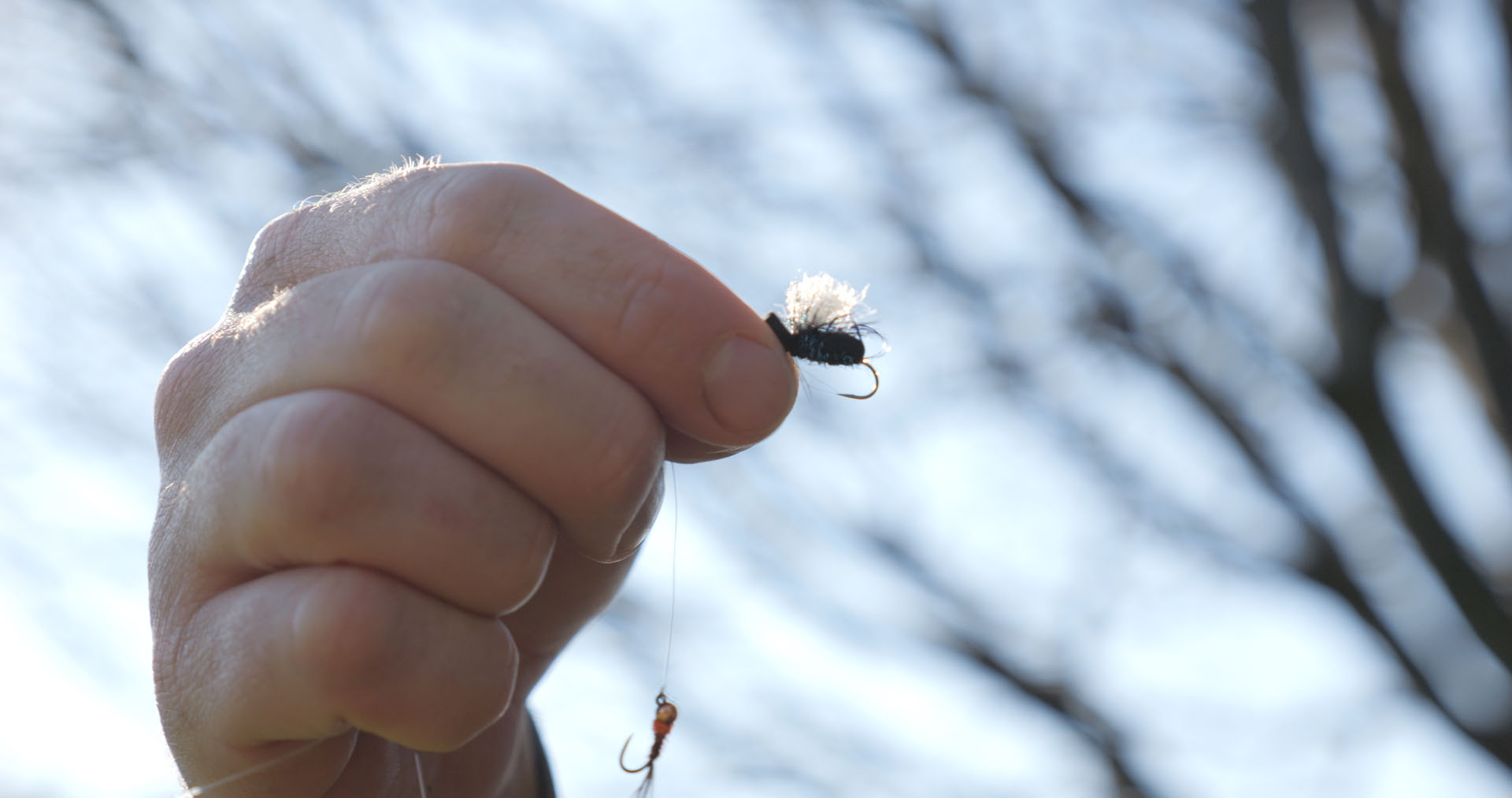
Reliable dry fly patterns include the Guides Tag, Royal Wulff, Possum Emerger, Parachute Dun and Shaving Brush.
Matt from Trout Tales Tasmania often reminds anglers that fly choice does not need to be complicated.
"A lot of anglers arrive in Tasmania with fly boxes packed full of patterns they'll never actually tie on. In reality, trout across our lakes and rivers respond consistently to a small group of proven flies. The key is learning to recognise the feeding clues trout show on the water rather than constantly swapping flies."
Essential Dry Fly Patterns
Guides Tag
A fantastic general purpose dry fly that works in many situations, from searching large areas of water and windlane fishing to early morning midge fishing and presenting to cruising fish. This is our best all round fly. Shop the Guides Tag
Royal Wulff
A great general purpose dry fly that will rarely let you down. It is best fished as a single fly on a long leader when sight fishing to rising or cruising fish in lakes or rivers. Shop the Royal Wulff
Possum Emerger
As a dry fly, this one has probably caught more fish in Tasmania than any other. Its subtle, natural appearance and low profile can be mistaken for a variety of hatching insects, and it is most effective when mayfly are around. Shop the Possum Emerger
Parachute Dun
An imitative dun pattern used when mayfly duns are actively hatching and can be seen on the surface. It is also a great fly to fish in a team of dry flies as a top or middle dropper. Shop the Parachute Dun
Shaving Brush
An emerging mayfly pattern that works any time after the first dun hatch of the season. The upright deer hair post makes it easy to see, and it is a favourite for searching lake edges and windlanes at the start of the day. Shop the Shaving Brush
Many anglers also find it helpful to begin with a curated selection of flies rather than choosing patterns individually. The Trout Tales Tasmania fly combo packs bring together proven fly patterns that regularly produce trout across Tasmanian lakes and rivers. The Ultimate Tassie Combo Box (20 Pack) is the most complete of these, pairing two of each pattern needed to cover lakes, rivers and streams in one box.
Terrestrial Flies for Summer Conditions
Highland lakes such as Penstock Lagoon, Arthurs Lake, Little Pine Lagoon and Currawong Lakes often produce some of the best terrestrial fishing in Australia during summer.
"When summer arrives you'll often see trout cruising the lake edges looking for terrestrials. Beetles and ants end up in the water constantly, especially when the wind picks up. Trout quickly learn to patrol those food lanes and become very opportunistic feeders," says Matt.
Patterns such as the Fiery Brown Sedge Hopper, Simons Stonefly and Blue Damsel are key flies to include in a Tasmanian fly box during summer.
Fiery Brown Sedge Hopper
Our best all round dry fly for when the fish are looking up. The brown body is suggestive of a mayfly, while the hopper legs are more imitative of a terrestrial insect. If fish are rising and you are not sure what they are feeding on, this fly will bring them up. Shop the Fiery Brown Sedge Hopper
Simons Stonefly
The best imitation of the Tasmanian giant stonefly we have used. It is a large, buoyant dry that works as a searching fly on lakes and rivers, and its visibility makes it perfect for hanging a nymph underneath. Shop the Simons Stonefly
Blue Damsel
Trout feeding on damselflies are renowned for being difficult to fool, but not for this fly. Present it near a feeding fish, then slowly twitch it on the surface to imitate the movement of a damselfly. Shop the Blue Damsel
Nymphs, Wets and Streamers for Subsurface Feeding
Although dry fly fishing receives most attention, trout frequently feed below the surface on nymphs, wets and streamers imitating insects, baitfish and other aquatic creatures.
Common subsurface patterns include the Tassie Devil Nymph, Copper Bead Pheasant Tail Nymph, Orange Bead Black Nymph, Shrek, MKII Woolly Bugger and Orange Bead Straggle Bugger.
"Some of the most consistent fishing in Tasmania actually happens just under the surface. Trout spend a lot of time feeding on nymphs and emerging insects that anglers never see. Learning to recognise subtle takes below the surface is a skill many anglers develop after spending time on Tasmanian lakes," says Matt.
Tassie Devil Nymph
A go to river nymph for euro nymphing or nymph under dry fishing when you are exploring new water or are not sure what to tie on. The jig hook lets it fish close to the river bed without getting snagged. Shop the Tassie Devil Nymph
Copper Bead Pheasant Tail Nymph
One of the most reliable river nymphs you can have, and a great starting point when you arrive at a river. It can represent mayfly and many other small insects, and works for euro nymphing, nymph under dry or fishing beneath an indicator. Shop the Copper Bead Pheasant Tail Nymph
Orange Bead Black Nymph
A fantastic lake nymph that combines a natural body with a bright bead to get a fish's attention. It fishes best on a floating line, hanging under a dry fly or slowly retrieved as a point fly. Shop the Orange Bead Black Nymph
Black Bead Claret Nymph
Claret has always been an irresistible colour for trout, particularly when mayfly are present. This nymph is super reliable in both lakes and rivers and can be fished under an indicator or slowly retrieved across weed beds. Shop the Black Bead Claret Nymph
Gold Bead Pink Tag Nymph
A deadly river nymph for euro nymphing or nymph under dry fishing. The jig hook lets it fish very close to the river bed, and it is a particularly good choice when the river is high and the water is coloured. Shop the Gold Bead Pink Tag Nymph
Shrek
Probably the wet fly that has caught more fish in Tasmania than any other, and often the first fly tied on for the day on the highland lakes. The tried and tested colours of green, gold and red can be fished with great confidence. Shop the Shrek
MKII Woolly Bugger
The only wet fly you need early in the season around flooded lake margins when fish are hunting bait fish and frogs. It is light enough for a slower sink rate but still has a bulky profile that moves water. Shop the MKII Woolly Bugger
Orange Bead Straggle Bugger
Orange beaded magoo style flies are probably the most productive wet flies on lakes around Australia. This one adds UV flash dubbing and is effective all season, fished by itself around lake edges or in a team of loch style flies. Shop the Orange Bead Straggle Bugger
Chartreuse Straggle Bugger
The chartreuse bead offers an alternative to the orange beaded version and can often spark some action if things are quiet. The UV flash dubbing adds extra flash, and it is effective all season around lake edges or in a team of loch style flies. Shop the Chartreuse Straggle Bugger
Fuzzle Bugger
Our top pick for an unweighted wet fly. The brushed dubbing gives it extra movement, and it is generally used as a top dropper with a bead head fly on the point. It has a great flashy action and sits high in the water. Shop the Fuzzle Bugger
Black and Red Streamer
Red and black has long been a great colour combination for trout. It is deadly early and late in the season when fish are targeting bait fish around the lakes, and a fantastic point fly in a team of loch style wets. Shop the Black and Red Streamer
Pink and Black Streamer
A fantastic early season fly on the lakes when there are large populations of bait fish and trout fry around. The pink flash stands out in coloured water, and it is a deadly point fly in a team of loch style wets or twitched along rocky lake edges. Shop the Pink and Black Streamer
Tasmanian Fly Box Checklist
The following mix of flies covers most Tasmanian fishing situations, and every fly below is available in the Trout Tales Tasmania shop:
- Dry Flies: Guides Tag, Royal Wulff, Possum Emerger, Parachute Dun, Shaving Brush
- Terrestrials and surface flies: Fiery Brown Sedge Hopper, Simons Stonefly, Blue Damsel
- Nymphs: Tassie Devil Nymph, Copper Bead Pheasant Tail Nymph, Orange Bead Black Nymph, Black Bead Claret Nymph, Gold Bead Pink Tag Nymph
- Wet Flies: Shrek, Orange Bead Straggle Bugger, Chartreuse Straggle Bugger, Fuzzle Bugger
- Streamers: MKII Woolly Bugger, Black and Red Streamer, Pink and Black Streamer
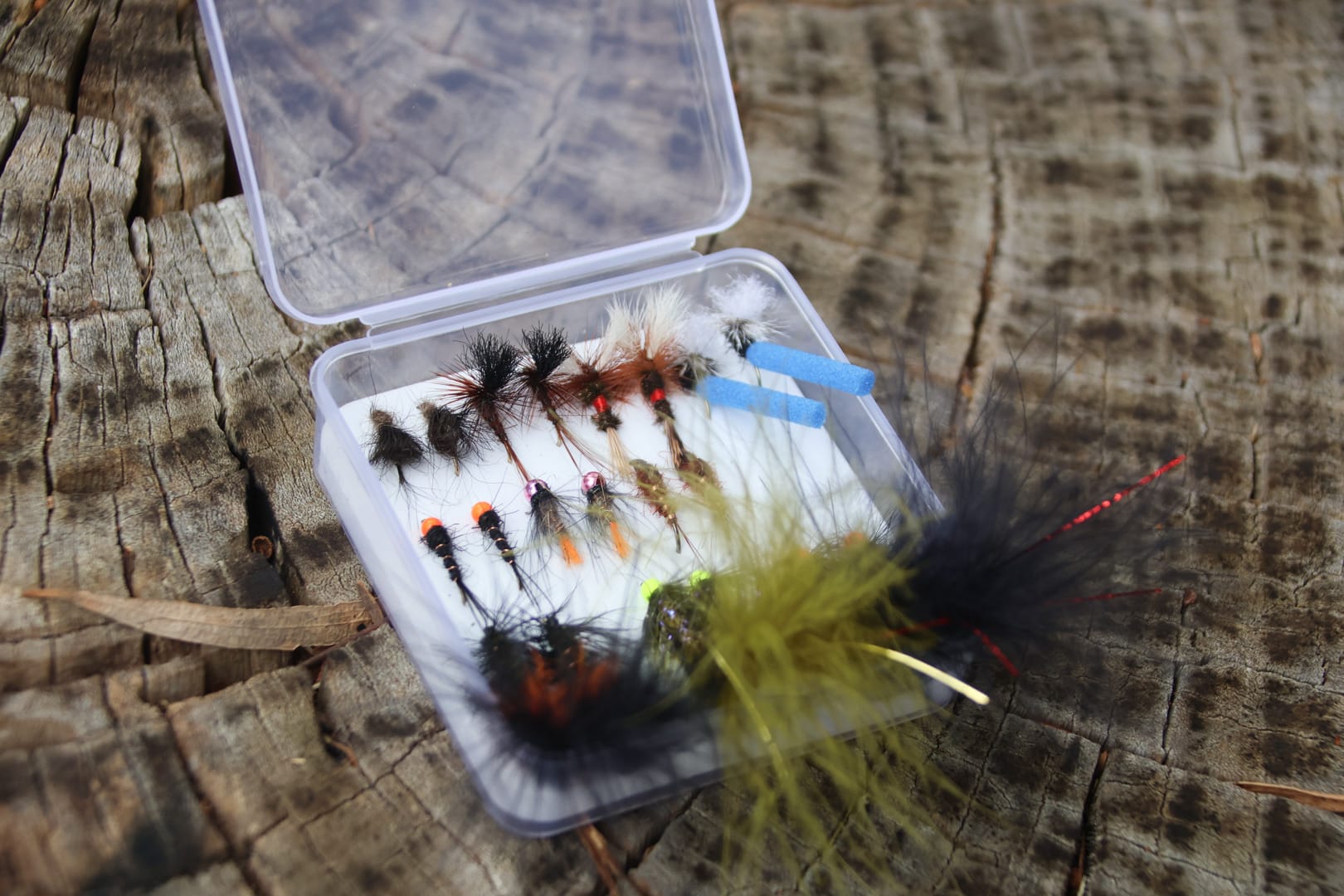
Anglers short on time can skip the fly-by-fly shopping list altogether with the Ultimate Tassie Combo Box (20 Pack), a ready-made box of ten trusted patterns, two of each, covering dries, nymphs, wets and streamers across lakes and rivers in one purchase.
Frequently Asked Questions
What flies do I need for Tasmanian trout fishing?
A focused mix of around 20 dry flies, terrestrials, nymphs, wets and streamers covers most Tasmanian fishing situations, and the Ultimate Tassie Combo Box (20 Pack) is a ready-made starting point.
What is the best all-round Tasmanian trout fly?
The Guides Tag is our best all round fly, a general purpose dry that works for searching water, windlane fishing and presenting to cruising fish on lakes and rivers.
Do I need different flies for lakes versus rivers?
Lakes tend to favour wet flies and terrestrials, while rivers favour dry flies and nymphs, though a well-rounded box covers both.
The Ultimate Tassie Combo Box (20 Pack)
If you would rather skip the fly-by-fly shopping, the Ultimate Tassie Combo Box (20 Pack) includes two each of the Possum Emerger, Choc Para Dun, Royal Wulff, Blue Damsel, Orange Bead Black Nymph, Tassie Devil Nymph, Brown Potscrubber Nymph, MKII Woolly Bugger, Orange Bead Black and Red Streamer and Chartreuse Bead Straggle Bugger. It is built to let you fish any technique required on the day, match hatches and fish different depths.
Final Thoughts
Building a practical Tasmanian fly box does not require hundreds of flies. A small group of well-chosen patterns can cover most trout feeding situations across Tasmania's lakes and rivers.
For anglers wanting to get sorted quickly, the Ultimate Tassie Combo Box (20 Pack) is a straightforward way to arrive with a complete, proven fly selection rather than sourcing each pattern individually.
For many visiting anglers, time on the water with experienced local guides helps build confidence with fly selection and trout behaviour far more quickly. If you are planning a trip, you can learn more about the guided fly fishing experiences and packages offered by Trout Tales Tasmania, or contact Matt to discuss seasonal conditions and suitable fly selections before arriving.

Hi, I'm Matt Stone - for over fifteen years I’ve developed my passion for fly fishing, wild trout and for the amazing places experienced in Tasmania along the way.
Feature Posts
Ready to book A trip?
Experience all of what fishing in Tasmania has to offer through a personalised fly fishing tour.
Book Now